
A Guide to swimming Pool Heat Pumps
Wouldn’t it be great if you could open your pool earlier in the spring or keep it open later into Autumn? Or maybe even winter? There’s nothing quite like swimming in a nice, warm pool when it’s cool outside.
Get a SunSwim swimming pool heat pump, and you can have that experience.
So…
Simply put, it’s an appliance to heat your swimming pool water,
Swimming Pool heat pumps differ from gas and electric heaters in that they don’t produce heat they transfer it.
The Heat pump draws heat out of the air that has been warmed by the sun, and transfers that heat to your pool water.
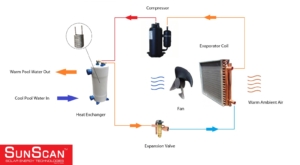
Your swimming pool pump circulates the pool water through a heat ex-changer inside the unit,
the heat pump contains a liquid refrigerant, a fan and a compressor that is powered by electricity.
The fan draws warm air over the evaporator coil and preheats the refrigerant; the warmer the ambient temperature, the more heat is absorbed.
The refrigerant boils at a very low temperature and turns into a gas (vapor), the gas is compressed to further increase its temperature, the heated gas then flows through the condenser coil in the Heat ex-changer.
As it moves through the heat ex-changer, the gas transfers its heat to the pool water circulating through the other side of the heat ex-changer. The refrigerant and pool water are never in direct contact.
The then cooled refrigerant starts the process over.
Because it is transferring heat and not generating it, a heat pump uses very little electricity when compared to alternative heating solutions, making it an efficient and cost-effective method for heating your swimming pool.
The unit’s ability to heat the water passing through it efficiently depends, in part, on the warmth of the ambient air drawn into the heat pump. The warmer the air is outside, the quicker it will heat and the warmer your pool will be.
Swimming pool heat pumps require an “initial heat”, this refers to the uninterrupted time it takes to heat your pool to the desired temperature (from cold), this is usually done straight after installation or if the heat pump has been off for some time and the water temperature has dropped substantially. Based on your requirements and the size of the heat pump this could take up to 84 hours to achieve a 10ºC increase, After the “initial heat” in most instances the temperature achieved only needs to be maintained, the heat pump can then run in conjunction with your regular pool maintenance schedule.
In some instances, a pool cover, or “blanket” may be required to assist in the prevention of heat loss. Swimming pools with covers lose less heat, less water and require less maintenance than those without covers.
Although they achieve the same result, there are two main “types’ of swimming pool heat pumps, Inverter technology and standard on/off types, the biggest difference between the two although there are several would be that Inverter type heat pumps have a variable speed compressor, in short this allows the compressor to determine and run at optimal speed based on its environment, thus increasing its efficiency and further reducing its electrical consumption, saving you even more money on utility and running costs.
You can contact one of our sales agents or use our online calculator to determine the correct size heat pump for your requirements, there are however some questions that can be answered before contacting them.
How Big is your swimming pool? (how many Litres / cubic meters, or length, breadth, and average depth)
Covered or uncovered? (a “blanket” reduces heat loss therefore a smaller unit may suffice)
What is your average pool temperature currently?
What is the set temperature you’re looking to achieve?
How quickly are you looking to achieve your set temperature?
What “type” technology heat pump? (Standard on/off or inverter type)
Area / Location? (where the heat pump will be installed, for coastal areas ABS plastic casing and or marine protective coatings are recommended)
Tripped Circuit Breaker
Is the heat pump on or off? Check the display, Check the circuit breaker, if that is on (up) push it down and then up again. If that’s not it, check to see if there are any other isolator switches near the heat pump, if all isolator switches are on and the unit is still off there may be a problem with the wiring or electrical supply, either in the breaker box or to the heat pump.
Important: Use caution when attempting to resolve an electrical issue, especially around water. If you do find an electrical issue, you’re not comfortable addressing yourself, don’t hesitate to call a professional.
Low Water Flow
It’s on, it’s working, but the pool just isn’t as warm as it should be, or it’s on but an error keeps popping up and switching the unit off.(identify the error code using the manual or contact an agent for error code listing).Low water flow is by far the most common error, and this is due to high “Gas” pressure caused by a poor heat exchange rate…in short…. low water flow.
Check and ensure that all shut off valves to and from the heat pump are open, check that the pool pump is working correctly and that all filters are clean and free of debris.
Clogged Evaporator Coil
A heat pump needs air to heat water. So, if the evaporator coil becomes clogged with debris, the air flow will be low and this will result in a heat pump that not only consumes more electricity but also takes longer to heat your water, or doesn’t heat at all.
Check the evaporator coil and remove any leaves, dirt, sticks, twigs, or any other debris that may have gotten caught in there.
Heat pump manufactures usually provide a cleaning/maintenance schedule with the unit as a guide, however environmental factors may require that more frequent cleaning be done, never use any harsh or corrosive detergents to clean the unit or the evaporator coil, even if a mild soap is used (sprayed on) ensure that it is thoroughly rinsed with a medium flow hose pipe. (take care not to damage any fins during the cleaning process)
Thermostat and temperature settings
Is the thermostat set to the right temperature? It needs to be set higher than the actual temperature of the water, try to set it between 3 ºC- 12 ºC higher than the water temperature, remember the ambient and water temperature will affect the set temperature or the time it takes to achieve your set temperature, lower ambient temperatures will also increase your heat losses in your swimming pool which will increase the heat pumps run time.
Ice
Let’s be honest. Finding ice on a heating appliance is rarely a good sign. However, in most instances this is not uncommon, and could be a result of a low ambient temperature, Most heat pumps do have a defrost cycle, so if ice appears it should clear (defrost) after a few minutes of running the unit.
When the temperature outside drops below 10°C, the refrigerant inside the unit is already approaching freezing temperatures. This can cause ice to form, clogging the heat pump and preventing it from running efficiently.
Check the outside temperature. If it’s often lower than 10°C (3-5 consecutive days), it’s time to adjust the run time schedule or turn the pool heat pump off for the season.
Icing can also indicate a refrigerant leak or problems in the refrigerant cycle, so if your heat pump is icing up regularly and its not due to low ambient temperatures or the unit is not defrosting after a few minutes of run time, you may need to call a professional.
Pressure Error
Are you getting a pressure error? You’ll need to check whether it’s too low or too high. (refer to the heat pump error code listing)
If the pressure is too low, chances are it’s too cold outside to operate the heat pump. In this case, you’ll have to turn it off and wait for the weather to warm up before using it again.
If the pressure is too high, you probably have a low water flow issue. See above
Leaks or Condensation
If you see water in or around the heat pump, don’t panic. Your first thought may be that it’s a water leak, but it could just be condensation forming and then dripping from the unit, this is normal. As the refrigerant goes through its cycle the temperature difference between the refrigerant inside the evaporator coil and the ambient air being drawn over the outside of the evaporator coil will cause condensate to form
Make sure that the condensation can drain freely from the unit, remove any debris from the drain hole and drainpipe, water (condensation) collection in the unit over time could start rusting components and limit the lifespan of your heat pump.
If All Else Fails, Call a Pro
If none of these remedies work, or you’re unable to find the problem, or it’s something you’re not comfortable fixing on your own, call a pro.